What "personal care" actually means at home
Personal care — sometimes called personal care assistance, attendant care, or PCA — is hands-on help with the activities of daily living. ADLs are the small but essential tasks most adults handle without thinking: bathing, dressing, toileting, transferring from bed to chair, eating. When even one of these becomes painful, unsafe, or genuinely difficult, the whole day starts to bend around it. Personal care is the practical solution to that.
What it covers in a typical Baton Rouge home: bathing and showering with attention to safety and modesty, hair care and shaving, oral and denture care, nail care, dressing (including weather- and event-appropriate clothing), toileting and incontinence care, skin checks for early pressure injury or bruising, transfers in and out of bed or car or bathroom, walking support with a cane or walker, and gentle range-of-motion exercises. It also covers the small invisible tasks that anchor a day — the morning routine, the bedtime routine, the cup of coffee at the right temperature.
Personal care is non-medical. That distinction matters because it shapes the entire experience: a personal care attendant is in the home as a steady, trained, compassionate presence — not as a clinician. The relationship is closer to a trusted family helper than a hospital staff member, and most families find that the right caregiver becomes part of the household within the first month.
The dignity problem nobody talks about
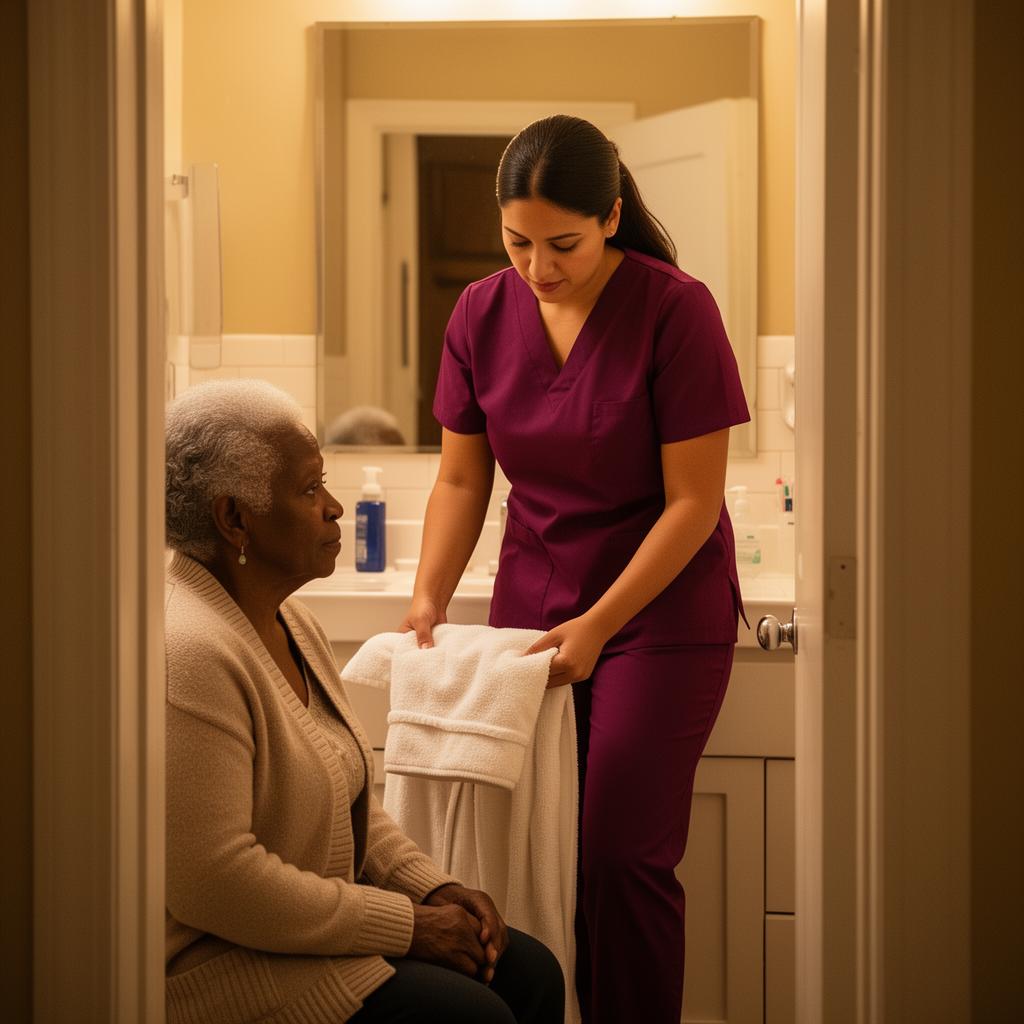
When families ask us "what is the hardest part of personal care," they expect us to say something physical — transfers, bathing, the heavy lift. It almost never is. The hardest part is dignity. Bathing and toileting are not just physical tasks; they are some of the most private, emotionally loaded moments of a person's life. A 78-year-old who raised four children, ran a business, and never asked anyone for anything is now being helped onto a toilet by a stranger. Nothing about that is small.
The families who do this well — and the agencies who do this well — never pretend that part is not there. They name it. They go slowly. They let the parent set the pace. They use small dignities consistently: a robe before stepping out of the shower, a knock before entering the bathroom, a closed door even when no one is in the hallway, the same caregiver every visit so it is never a new face during the most vulnerable moments of the day.
When dignity is honored, personal care stops being a loss and becomes something closer to a partnership. We have watched parents who fought help for months become genuinely fond of their caregiver, ask for them by name, and look forward to the visits. The shift happens because the caregiver was not just competent — they were respectful from the first minute.
What a personal care attendant does in a typical visit
A typical visit is paced. A four-hour morning visit might begin with a quiet greeting, a check on how the night went, and a cup of coffee at the kitchen table while the day's plan settles in. Then the bathroom and shower, with a shower bench, a handheld showerhead, the soap that smells like home, and a robe ready on the hook. Then dressing in clothes appropriate for the day. Then breakfast — often shared at the table, because eating alone is one of the fastest ways for older adults to stop eating. Then medications (as a reminder, not administration), light tidying of the bedroom, a load of laundry started, and a short walk in the hallway or to the porch if the weather allows.
An evening visit looks different. Bathroom, pajamas, oral care, evening medications, a calm wind-down activity, sometimes a shared cup of tea, and bedtime. The work is straightforward; the value comes from the consistency, the gentleness, and the trained attention to small changes — a slower walk this morning, a meal half-eaten, a new bruise nobody mentioned.
What a personal care attendant CANNOT do (clinical/medical line)
Louisiana law and best practice draw a clear line between non-medical personal care and skilled medical care. Knowing the line matters because it determines what kind of help you actually need.
- •Cannot administer medications — this means cannot pour, push, or place medications into your parent's mouth. We can remind, set up the pillbox with the family, hand the pre-filled box, and verify the dose was taken. Administration requires a licensed nurse.
- •Cannot give injections (insulin, blood thinners, anything else)
- •Cannot perform sterile wound care, change surgical dressings, or manage IV lines
- •Cannot suction airways or manage tracheostomies
- •Cannot crush pills into food unless a doctor has specifically ordered it
- •Cannot diagnose, recommend medications, or change a care plan without coordinating with the medical team
When skilled medical care is needed, it usually comes from home health (a separate, doctor-ordered service often covered by Medicare). Many families use both side by side — home health for the medical visits, home care for the daily presence. Our overview of how home care and home health work together explains the handoff.
Need personal care help in Baton Rouge? Let's talk first.
How to know it's time for personal care help
Most families do not decide on a single day. They notice a pattern of small things over months and one moment finally tips it — a fall, a missed medication, a hospital discharge, an exhausted spouse. The signs to look for, building over weeks rather than days:
- •Hair, nails, or clothing look less cared for than usual
- •A familiar smell that was not there before
- •Bruises with no clear story (often the first sign of unreported falls)
- •Avoiding the shower or wearing the same outfit two days in a row
- •Mornings have become a long, exhausting effort that is leaving your parent depleted by 10 a.m.
- •The spouse who has been the primary caregiver is showing burnout signs
- •A recent hospital stay and a discharge plan that requires more than the family alone can sustain
If you are seeing two or three of these together, our guide on the 10 signs a loved one may need home care goes deeper. The honest test: if you are losing sleep about your parent's morning, it is time for a conversation, not a verdict.
How we hire and train our personal care attendants in Baton Rouge
Personal care lives or dies on the person in the home. The best care plan in the world fails with the wrong caregiver, and a great caregiver makes a difficult situation feel manageable. Our hiring process reflects that.
- •Every caregiver completes a full background check (state and federal), motor vehicle records check, and reference verification before they are hired
- •Direct Service Worker registry verification through the Louisiana Department of Health
- •In-person interviews focused on temperament and chemistry, not just credentials
- •Onboarding training in body mechanics, transfer technique, infection control, dementia communication, and the dignity standards we hold ourselves to
- •Aging Gracefully brings clinical expertise, our training pays unusual attention to medication safety — the side effects that look like illness, the warning signs caregivers should report, the medications most likely to cause falls
- •Ongoing training and supervision, not a one-time orientation
- •Insurance and bonding so the family is protected from the first visit
When we match a caregiver to a family, we look at temperament, language preference, schedule fit, and the specific care needs in front of us. If the chemistry is not right after the first few visits, we re-match without making it a big deal. Familiarity matters in personal care, and we work hard to keep the same trusted face in the home week after week.
What to expect on your first visit with Aging Gracefully
The first visit is free, in your home, and unhurried. We typically spend 60 to 90 minutes. The goal is not to sell you on care — it is to understand the situation well enough that we can tell you honestly whether we can help.
- We listen first. What is happening in the household, what is working, what is not, what brought you to call.
- We meet your parent on their terms, not ours. If they are skeptical, we are patient. If they are eager to talk, we are good listeners.
- We walk the home if you want — looking for fall risks, bathroom safety, the small things you have stopped seeing.
- We talk through what care could look like — visit schedule, hours, who would come, how the introduction would work.
- We give you a real number. Hourly rate, weekly cost, and how each potential payment source (long-term care insurance, VA benefits, Louisiana Medicaid waivers) might apply.
- We leave you to decide. There is no follow-up sales call, no pressure. When you are ready, you call us. Many families call back weeks or months later, and that is fine.