
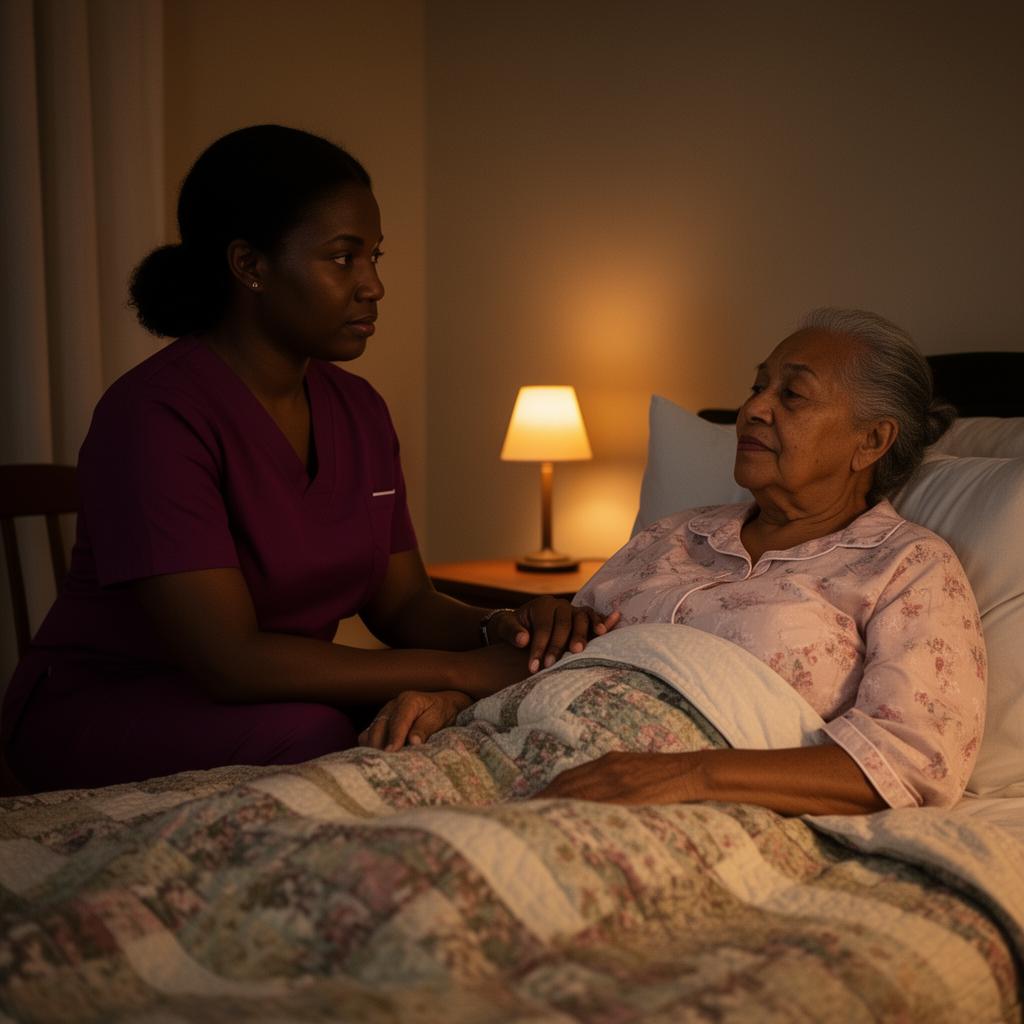
When nights become unsafe — wandering, falls, anxiety
For most families, the breaking point is not a single night. It is a slow accumulation: a fall on the way to the bathroom at 3 a.m., the front door found unlocked at sunrise, the wandering that has started after dinner, the sundowning anxiety that lasts until midnight, the spouse-caregiver who has not slept through the night in eight months. The day shift can be managed. The night shift cannot.
Nighttime is harder for older adults than days for several reasons that compound. Vision is worse in low light, balance is worse when sleepy, blood pressure drops on standing (orthostatic hypotension), the bathroom trip is rushed because of bladder urgency, dementia symptoms intensify after dark (sundowning), and there is no one to call out to. The same person who is steady at noon is genuinely fragile at 3 a.m.
Signs nights have become unsafe in your parent's home:
- •Wandering or trying to leave the house at night
- •Falls between bed and bathroom (or any other unwitnessed fall)
- •Sundowning anxiety that lasts past bedtime
- •Forgetting how to get back to bed once up
- •Not changing into pajamas — sleeping in day clothes
- •Calling family or 911 in the middle of the night repeatedly
- •The spouse caregiver has not slept through the night in months
- •Recent hospital discharge with new mobility limits or new medications
Awake-overnight care vs. sleep-in care (the difference matters)
There is a critical distinction families need to understand before they price overnight care, because the wrong model can be either dangerous or wasteful.
- •Awake-overnight: the caregiver is awake and active for the entire shift (typically 8-12 hours overnight). Used for clients with active nighttime risks — dementia wandering, frequent bathroom trips with fall risk, sundowning, post-hospital recovery, or any situation where supervision is needed continuously through the night.
- •Sleep-in / live-in: the caregiver sleeps in the home but is available if the client needs help. Lower hourly rate, but only appropriate when the client typically sleeps through the night and only needs occasional support. The caregiver still needs sleep — usually 8 hours of uninterrupted rest is required by labor regulations and by basic human need.
The wrong choice in either direction creates problems. Choosing sleep-in for a client who actually needs awake-overnight means the caregiver is woken up every hour, cannot function the next day, and the supervision is ineffective when it matters most. Choosing awake-overnight for a client who actually sleeps through the night means paying for hours of supervision the family does not need. We help you figure out which model fits during the free visit by talking through what nights actually look like in the home.
What an overnight caregiver actually does between bedtime and morning
An awake-overnight shift is paced and intentional. It does not look like watching someone sleep — it looks like being a calm presence in a quiet house, alert to the moments that matter and unobtrusive the rest of the time.
A typical evening through morning shift:
- Arrival before bedtime, not after — usually 7-9 p.m. The caregiver enters when your parent is still up so they are a familiar presence going into the night, not a startling new face at midnight.
- Helps with the bedtime routine — bathroom, pajamas, oral care, bedtime medications (as reminders), the light reading or music or TV that signals it is time to wind down
- Sees your parent safely into bed and confirms they are settled
- Through the night: present in the home (typically in a chair near the bedroom or in an adjacent room with the door open), responding to bathroom trips, anxious moments, occasional wandering, or pain. Some shifts are quiet; others involve helping up to the bathroom four or five times.
- Charts every interaction — bathroom trips, sleep quality, any incidents — so the family and the daytime caregiver have a clear picture
- Light tasks during quiet stretches: a load of laundry, dishes, tidying, charting
- In the morning, helps with the wake-up routine — bathroom, dressing, breakfast prep, morning medication reminders
- Hands off to family or the daytime caregiver before leaving, with a quick verbal report on how the night went
Worried about nights at home? We can stay with them.
Cost differences between awake-overnight and live-in
Cost is one of the most common questions families ask about overnight care, and the answer depends heavily on which model fits.
- •Awake-overnight: priced hourly at our standard rate, multiplied by 8-12 hours per shift. This is the higher-cost option but the right one when supervision is needed continuously through the night.
- •Sleep-in / live-in: typically billed as a flat-rate shift (significantly lower than awake-overnight) because the caregiver is getting protected sleep time. The model only works when your parent reliably sleeps through the night and the caregiver is needed only for occasional support.
- •Long-term care insurance often covers overnight care; check the policy language for "24-hour care," "live-in," or "overnight" benefits.
- •VA benefits (Aid & Attendance, Veteran-Directed Care) can contribute to overnight care for qualifying veterans and surviving spouses.
- •Louisiana Medicaid waivers may cover overnight hours for eligible participants — the Community Choices Waiver in particular.
We will give you a real number after the free visit and walk through which payment sources apply. Our cost of home care guide covers the broader pricing picture.
When 24-hour rotating shifts make more sense than live-in
For clients who genuinely need someone awake and active around the clock, 24-hour care is built from rotating shifts (typically two 12-hour shifts or three 8-hour shifts) rather than one live-in caregiver. The reasons matter:
- •Awake supervision the entire 24 hours requires a fresh, rested caregiver — one person cannot do that safely
- •Two or three caregivers rotating means the team has built-in backup coverage when one is sick
- •Different caregivers can specialize in different parts of the day — the morning caregiver handles bathing and breakfast, the day caregiver handles outings and meals, the overnight caregiver handles bedtime and night supervision
- •Compliance with Louisiana labor regulations and worker safety standards
Live-in is a real and useful option for clients who sleep through the night reliably. 24-hour rotating is the right model for clients with active nighttime risks. Sometimes families start with live-in and step up to 24-hour as needs change; that transition is something we plan for in advance whenever possible.
How to set up overnight care in Baton Rouge — the first 72 hours
If you have decided overnight care is needed, the first 72 hours of setup determine whether the transition is calm or chaotic. The pattern that works:
- Free in-home visit during daytime — we meet your parent on familiar terms, walk the home, and talk through what nights look like. We figure out which overnight model fits.
- Caregiver introduction during a daytime visit before the first overnight. Your parent meets the overnight caregiver in regular light, with you there. By the time the caregiver shows up at 7 p.m. for the first shift, they are a familiar face.
- First overnight shift, usually within 3-7 days of the initial visit. For urgent situations (post-discharge, recent fall, family caregiver collapse), we can often start the same day or the next.
- Daily check-in for the first week. The family and the agency talk every morning about how the night went. We adjust the routine based on what we learn.
- Care plan refined at 14 days. By two weeks in, we know your parent's nighttime pattern, what works, what does not, and the schedule has stabilized.