
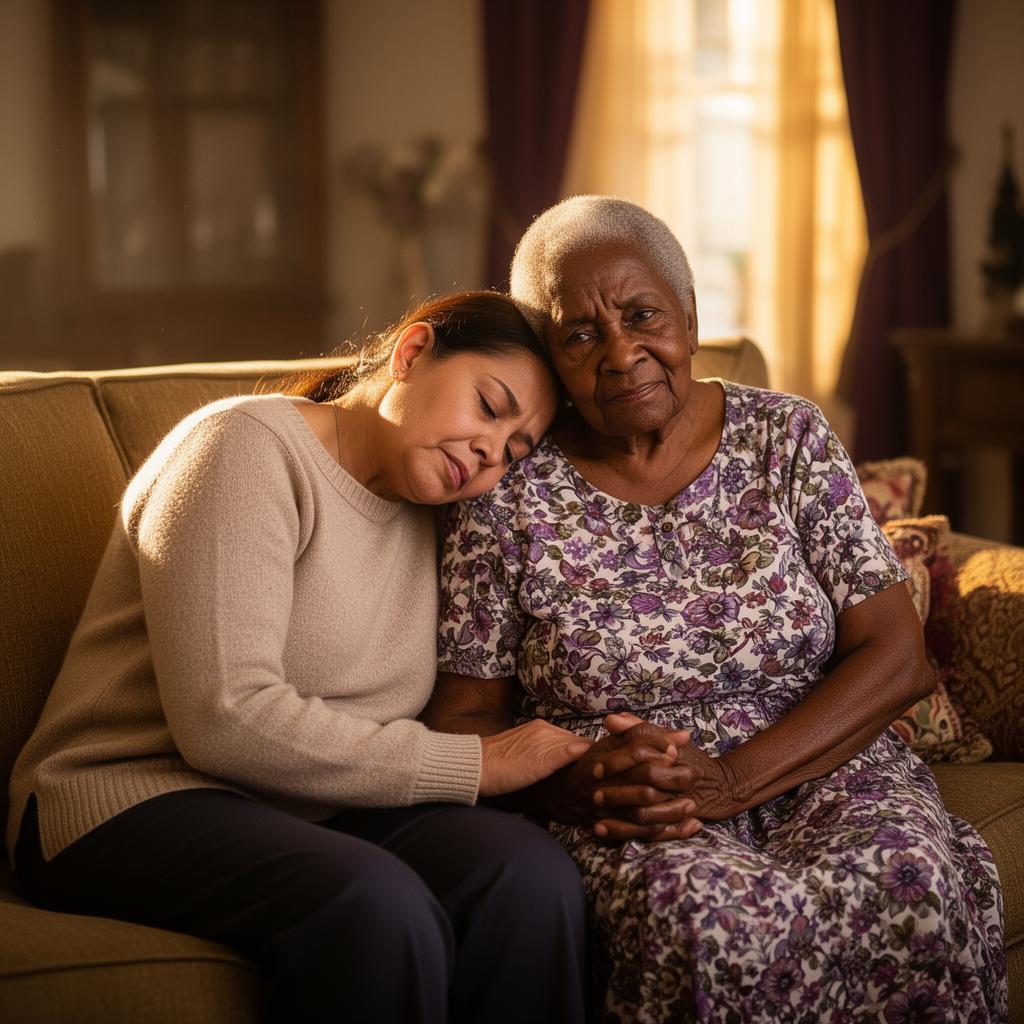
The 7 quiet signs of family caregiver burnout
Burnout almost never announces itself. It builds quietly over months — sometimes years — until one ordinary day you find yourself crying in the car or snapping at the person you love most. By the time most family caregivers call us, they have been in burnout for six to twelve months and assumed it was just how life is now.
- •Exhaustion that sleep does not fix — you wake up tired even on the rare night you get eight hours.
- •Resentment toward the person you are caring for, followed immediately by guilt for feeling that way.
- •Withdrawal from your own friends, hobbies, and activities. The things that used to make you feel like yourself feel impossible to fit in.
- •Snapping at people you love over small things. Your spouse, your kids, the cashier at the grocery store.
- •Frequent illness, headaches, gut problems, or chronic muscle pain. The body keeps the score when the mind tries to push through.
- •Crying for no reason — or the opposite, feeling numb when you used to feel something.
- •Fantasies about something happening that ends the caregiving — a hospital stay, a move to a facility, even your loved one's death — followed by deep shame for thinking it.
If three or more of these are true for you, you are not weak and you are not a bad caregiver. You are doing what an entire team of professionals normally does, alone, without breaks, often without thanks. The body and mind are responding the way any body and mind would.
Why "I'm fine" is the most dangerous sentence
The single most predictive sentence we hear from family caregivers heading toward collapse is "I'm fine." It is what they say when their sister calls. It is what they say to the doctor at their own annual physical. It is what they tell themselves on the drive home from the pharmacy at 9 p.m.
"I'm fine" is dangerous because it ends the conversation. It tells the people who would have helped that they are not needed. It tells your own body that the alarm bells can be ignored a little longer. And it builds a story — "I am the one who handles things" — that becomes harder to walk away from the longer you tell it.
The healthier sentence is specific. "I am running on four hours of sleep." "I have not had a meal sitting down in two weeks." "I missed my own doctor appointment again." Specifics let other people actually help. Generalities — "I'm fine," "it is what it is," "I'll get through it" — guarantee they will not.
The physical cost — and what you may already be ignoring
Family caregivers have measurably higher rates of depression, anxiety, heart disease, and earlier mortality than non-caregiving peers their age. Long-term cortisol elevation from chronic stress weakens the immune system, raises blood pressure, accelerates cognitive decline, and shortens telomeres at the cellular level. This is not soft science. This is what happens to a body that runs on adrenaline for two years without recovery.
What family caregivers most often ignore: their own annual physical, their own dental appointments, weight gain or loss of 10+ pounds, new high blood pressure readings, sleep apnea symptoms (snoring, daytime exhaustion), persistent back or neck pain, and signs of depression they would never miss in someone else.
If a friend described your last six months to a doctor, what would the doctor say? That is the honest test.
If you've been carrying this alone, let's talk.
Three things to do this week if you're burning out
- Schedule your own doctor appointment — not your loved one's. The one you have been postponing. Burnout has medical consequences and deserves medical attention. Tell your doctor exactly what your week looks like, not the polished version.
- Find one guaranteed off-block this week. Three or four hours, same time, every week going forward. Not "when things calm down" — they will not calm down on their own. Use respite care, a sibling, a neighbor, a church friend. The block must be predictable, not opportunistic.
- Tell one person the unvarnished truth. Not "it is hard." The actual specifics — the sleep, the resentment, the fantasies, the fear. The relief of being honest with one person breaks the spell of "I'm fine."
How respite care, support groups, and rest fit together
Recovery is not one big intervention. It is three small, consistent practices that compound over weeks:
- •Respite care covers the hours of your week that are non-negotiable for your own survival — sleep, your own appointments, time with your spouse or kids, time alone. Our respite care guide walks through how to use it without guilt.
- •A support group — even one meeting a month — gives you the company of people who understand without explanation. The Louisiana Caregiver Resource Network and most major faith communities in Baton Rouge have caregiver groups.
- •Real rest — not collapsing on the couch, not scrolling. Actual sleep, time outside, exercise that moves your body, meals you sit down for. Caregivers underestimate how much basic recovery they need because they have not had any in so long.
The Louisiana Caregiver Resource Network and other Baton Rouge support
You are not the only family caregiver in Baton Rouge, and you do not have to invent the support system from scratch. The local network is real and most of it is free or low-cost.
- •Louisiana Caregiver Resource Network — statewide caregiver support, education, and connection to local resources.
- •Capital Area Agency on Aging — counseling, assessment, and referral for older adults and their families across Baton Rouge & Surrounding Areas.
- •Alzheimer's Services of the Capital Area — caregiver support groups, education, and respite resources specifically for dementia families.
- •Local faith communities — many large Baton Rouge churches run informal caregiver support groups; ask the pastoral care office.
- •VA caregiver support — for caregivers of veterans, the VA Caregiver Support Program offers training, counseling, and respite benefits.
- •Our team — for any of the above, we can point you to the right contact and walk you through what to ask for.
What we hear from families afterward is the same line, almost word for word: "I should have done this a year ago." The right amount of help, brought in early, lets you be a daughter or son or spouse again — not just a caregiver. That is what makes long-term care actually long-term.